
Botox and dermal filler treatments may be among the most recognizable procedures in aesthetic medicine, but learning how to perform them safely involves much more than memorizing injection points.
Licensed healthcare professionals entering aesthetics need education in anatomy, patient assessment, product selection, treatment planning, injection technique, and complication management.
If you’re searching for Botox and filler training in Florida, understanding what comprehensive injector education should include can help you take the next step in your aesthetic career.
What Is Botox and Filler Training?
Botox and filler training teaches licensed healthcare professionals how to assess patients and perform commonly requested injectable treatments.
Although the two treatment categories are often taught together, they work very differently.
Neuromodulators such as Botox are commonly used to temporarily reduce targeted muscle activity.
Dermal fillers are injectable products used to restore or add volume, enhance facial contours, and address specific aesthetic concerns.
Understanding those differences is fundamental to developing appropriate treatment plans.
Botox Training Should Teach More Than Injection Points
New injectors often begin by focusing on where injections should be placed.
But learning injection locations alone does not prepare someone to treat every patient.
Facial expressions, muscle strength, asymmetry, sex, age, anatomy, and previous treatments can all affect how a provider approaches neuromodulator treatment.
Comprehensive Botox training may include:
- Facial muscle anatomy
- Patient assessment
- Product preparation and dilution
- Injection technique
- Dosing principles
- Male and female treatment considerations
- Patient consultation
- Contraindications
- Adverse events
- Follow-up and treatment evaluation
The goal is to understand why a treatment plan is appropriate rather than simply copying predetermined injection patterns.
Dermal Filler Training Requires an Understanding of Facial Anatomy
Dermal filler treatments require additional knowledge of facial structure and vascular anatomy.
Providers should understand how different layers of the face contribute to appearance and how filler placement can affect facial proportions.
Training may address areas including:
- Lips
- Cheeks
- Chin
- Nasolabial folds
- Lower face
- Facial balancing
As injectors advance, they may also explore more complex treatment areas and techniques.
A strong foundation helps providers understand how individual treatments fit into the patient’s overall facial structure.
Patient Assessment Comes Before the Injection
One of the most valuable skills an injector can develop is the ability to create an individualized treatment plan.
A patient may arrive requesting a specific procedure because they saw it online or because a friend received the same treatment.
That does not necessarily mean it is the best approach for them.
Before treating, providers should consider factors such as:
- Facial anatomy
- Existing asymmetry
- Previous filler or neuromodulator treatments
- Medical history
- Patient expectations
- Treatment goals
- Contraindications
- Overall facial proportions
Great aesthetic medicine begins with assessment, not with the syringe.
Why Complication Training Is Essential
Botox and dermal filler treatments are medical procedures.
While many adverse effects are mild and temporary, injectors also need to understand how to recognize more serious complications.
Dermal filler education should include topics such as vascular compromise, product-related reactions, infection, asymmetry, and appropriate reversal protocols.
Neuromodulator education should likewise address unwanted effects, anatomical considerations, dosing, and appropriate follow-up.
Providers should leave training understanding not only how to perform a treatment but what steps to take if the outcome is unexpected.
Who Can Take Botox and Filler Training in Florida?
Eligibility to perform injectable aesthetic procedures depends on professional licensure, scope of practice, supervision, and other applicable regulations.
Medical aesthetics training programs commonly serve healthcare professionals such as:
- Registered Nurses
- Nurse Practitioners
- Physician Assistants
- Physicians
Before performing injectable procedures, providers should confirm the current requirements governing their individual license and practice setting in Florida.
Training and legal authorization to perform a procedure are separate considerations, so providers should understand both before beginning clinical practice.
Why Train in a Real Clinical Environment?
Medical aesthetics is fundamentally patient-centered.
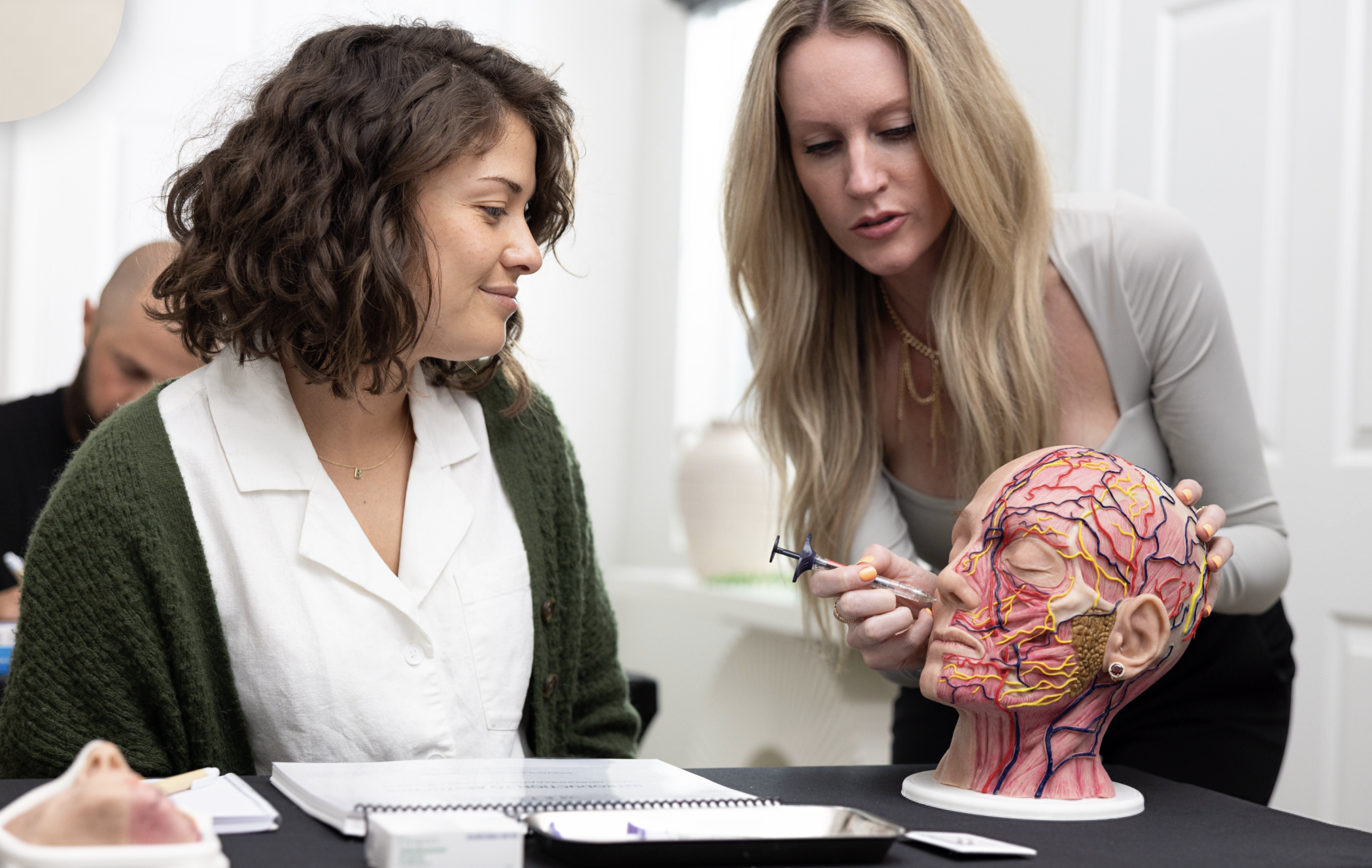
Training in a clinical setting exposes students to more than injection technique alone.
Providers can see how aesthetic care fits together from beginning to end:
Consultation → Assessment → Treatment Planning → Procedure → Aftercare
This helps students understand not only how to administer a product, but how an actual aesthetic appointment functions.
It also allows instructors to provide feedback as students begin translating classroom knowledge into clinical skills.
Small-Group Training Gives Injectors More Opportunities to Learn
Injector education benefits from individualized feedback.
Large lecture environments can provide valuable information, but medical professionals learning a new procedural skill also need instructors who can observe their technique.
Small-group training allows instructors to evaluate:
- Hand positioning
- Injection technique
- Patient positioning
- Treatment planning
- Product handling
- Clinical decision making
Students can also ask questions as they work rather than waiting until the end of a large presentation.
At Method Aesthetics Academy’s Pensacola medical aesthetics training location, classes are intentionally kept small, with the academy stating that class sizes do not exceed 12 students.
Botox and Filler Training in Pensacola, Florida
Pensacola provides an accessible destination for medical professionals throughout Florida and the Southeast seeking aesthetic injector education.
Method Aesthetics Academy offers medical aesthetics training from its Pensacola clinical training location.
Its foundational Upper Face Neuromodulators & Dermal Fillers Level 1 course includes instruction and hands-on training involving neuromodulators, lips, cheeks, and other facial areas, along with business and clinical education. Current course requirements specify an active RN, NP, PA, MD, or DO license.
This combination allows providers to develop both foundational knowledge and practical experience in one training environment.
What Should You Bring Home From Injector Training?
The value of training should not be measured only by whether you receive a certificate.
After completing foundational education, you should have a stronger understanding of:
- Facial anatomy
- Patient assessment
- Neuromodulator treatment
- Dermal filler treatment
- Treatment planning
- Injection technique
- Patient safety
- Complication recognition
- Appropriate follow-up
- Areas where you still need mentorship or additional education
Knowing your limitations is also part of becoming a responsible medical aesthetics provider.
Continue Building Your Skills After Training
Aesthetics is not a field you master after one class.
As providers gain experience, many continue their education through:
- Advanced injectable courses
- Shadowing
- Private training
- Mentorship
- Anatomy education
- Regenerative aesthetics
- Laser training
- Advanced facial balancing techniques
Continued education helps providers expand their treatment capabilities while strengthening the clinical judgment behind those treatments.
Find Botox and Filler Training in Florida
If you’re a licensed healthcare professional ready to develop your skills in aesthetic medicine, choosing comprehensive training is an important first step.
Method Aesthetics Academy provides Botox, dermal filler, and advanced medical aesthetics training in Pensacola, Florida, with an emphasis on small-group education, hands-on experience, clinical decision making, and patient safety.